
Garage Door Wind Ratings for Wheeling: What 2026 Storms and Your Insurer Actually Want
How garage door wind ratings (PSF) work, how to read your door's label, reinforcement options, and what a 2026 storm claim needs in Wheeling and Chicagoland.
A straight-line wind event rolls through the northwest suburbs almost every summer now. When it hits, the garage door is the first thing to give. It is the largest single opening on most Wheeling houses, and when it blows in, the wind does not stop at the cars. It pressurizes the whole structure and starts lifting the roof from the inside.
I have spent fourteen years on driveways across Cook County and Lake County, and the calls after a storm always sound the same. The door bowed inward, popped off the track alignment, and now it will not close. The homeowner files a claim, the adjuster asks for the wind-rating label, and nobody can find one because the door was never rated to begin with. That conversation is avoidable. This is the plain-English version of what a wind rating means, how to read your own door in about thirty seconds, and what actually moves the needle on a 2026 claim.
What a wind rating actually measures (and the unit everyone gets wrong)
Here is the first thing that trips people up. Garage doors are not rated in miles per hour. They are rated in pounds per square foot, or PSF, and the rating comes in two numbers: a positive pressure (wind pushing the door in) and a negative pressure (wind suction pulling it out). DASMA, the door manufacturers association, spells this out in its technical sheets, and the reason matters. A 110 mph gust does not put the same load on a 7-foot single door as it does on a 16-foot double. Door size, building exposure, and your exact address all change the math.
Those PSF numbers come from ASCE 7, the engineering standard that ties a design wind speed to a physical address. For most of Wheeling, Buffalo Grove, and the surrounding Cook County footprint, the design wind speed for a standard home lands in the neighborhood of 105 to 110 mph under current code. Your local permit office has the exact figure, and I always tell people to confirm it there before buying anything. A rated door is tested to ANSI/DASMA 108 or ASTM E330: ten seconds at its design pressure, then ten seconds at 1.5 times that pressure. If it holds, it earns a permanent label.
What a Chicagoland storm actually does to an unrated door
People picture a tornado. The damage I see is usually more boring and far more common: a 70 mph straight-line gust during a fast-moving Midwest winter front or a July derecho. The door flexes. The panels bow at the center where there is no support, the rollers walk out of the track, and a roller stem snaps or a hinge tears its screws loose. Sometimes the bottom bracket where the lift cable anchors lets go, and now you have a cable problem stacked on top of a wind problem.
Once the seal at the edges breaks, wind gets under the door and the failure speeds up. Freeze-thaw cycles all winter have already loosened fasteners and dried out the weather seal, so by storm season the door is weaker than it looks. I have pulled doors in Northbrook and Arlington Heights where the panel shift was so bad the sections no longer lined up, and the homeowner swore the door “was fine last week.” It was fine until the first real gust found the weakest hinge.
The thirty-second check: is your door storm-ready?
You do not need tools for the first pass. You need a flashlight and two minutes. Here is the exact order I walk through on an inspection, and you can do the first three steps yourself.
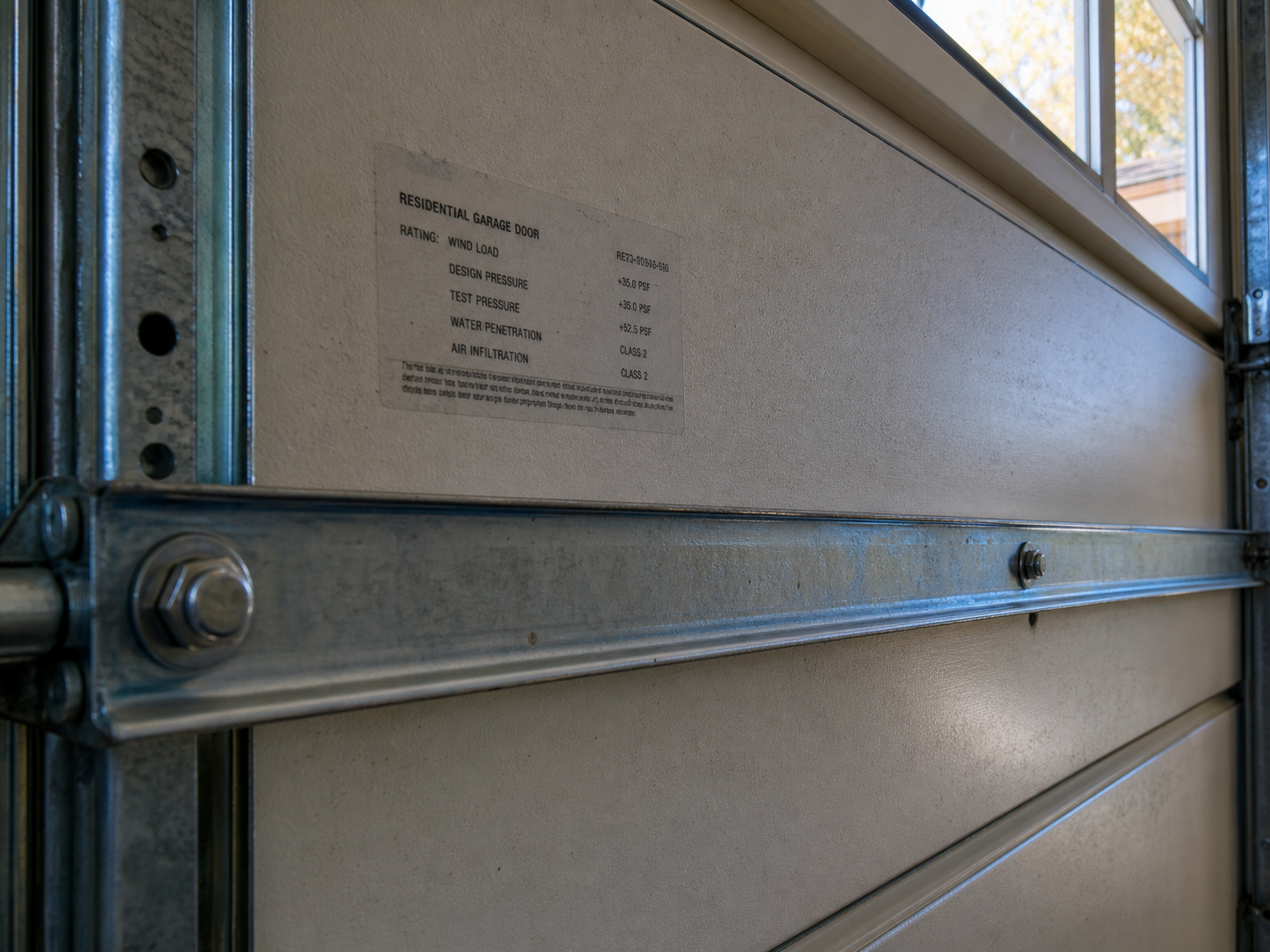
- Find the label. Look on the inside of a door panel near the edge, or on the back of the bottom section. A wind-rated door carries a permanent label with the manufacturer, the model, and the positive and negative design pressure in PSF. No label means no rating. Full stop.
- Count the struts. A wind-rated door has horizontal steel reinforcement bars, called struts or U-bars, across each section. A basic builder-grade door often has one strut on the top section and nothing else. More open span between supports means more flex in a gust.
- Run a balance test. Pull the manual release, lift the door halfway by hand, and let go. A healthy door holds. If it slams down or shoots up, the torsion spring is out of tune, and an unbalanced door takes wind loads far worse because the hardware is already stressed.
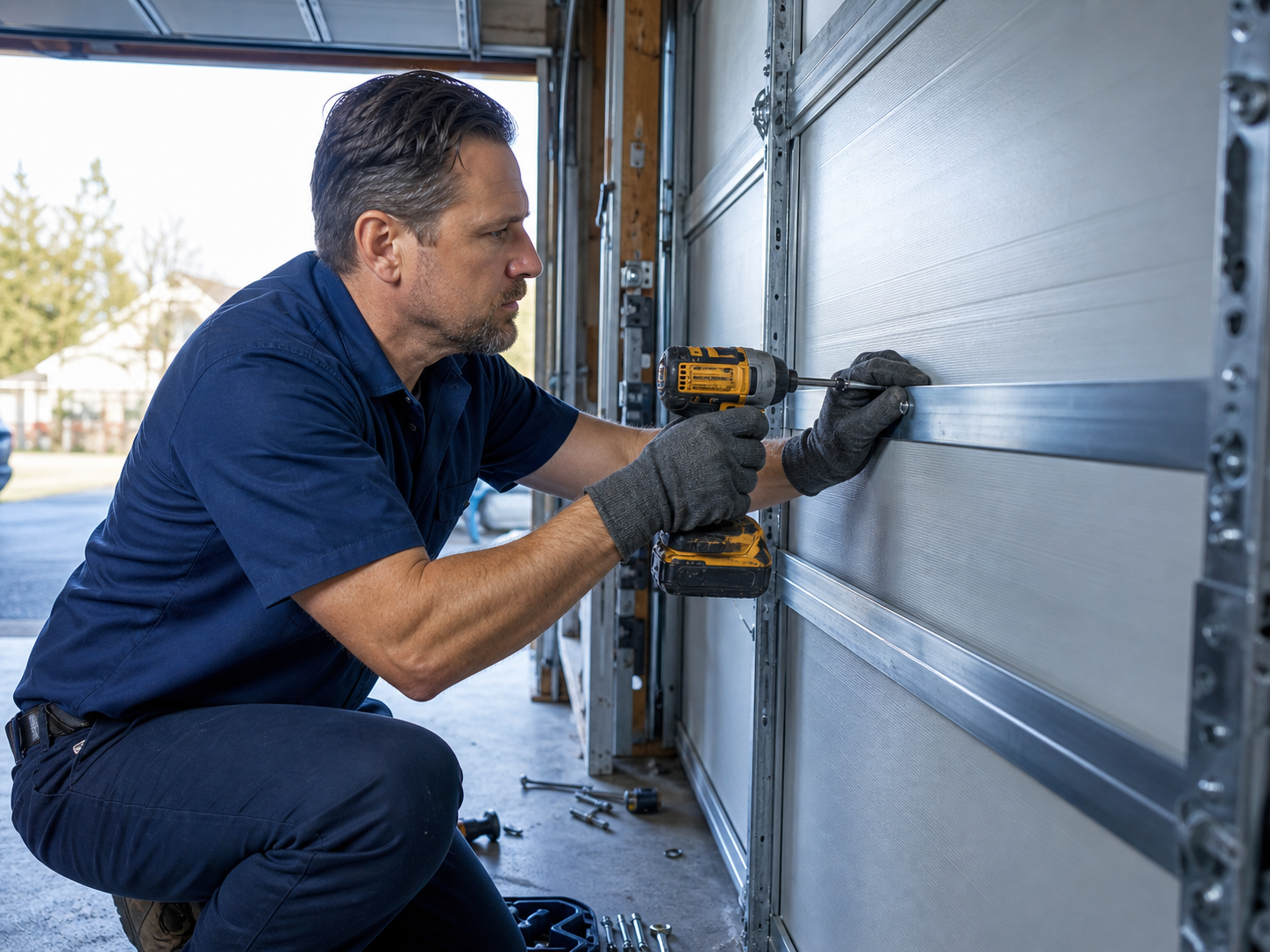
- Have a tech check the hardware. This is the part I do: track alignment, the bearing plate at the spring, every hinge and roller stem, and the bottom bracket. Wind finds the one loose fastener you cannot see from the floor.
If the door fails the first two steps, it is not rated, and no amount of caulk changes that. If it passes the label check but the hardware is tired, that is a repair conversation, not a replacement one. A worn-out door can sometimes be brought back to spec with new garage door roller repair and fresh hinges, and a sagging door usually points back to garage door spring repair before anything else.
Reinforcement options, cheapest to most involved
Not every door needs to be ripped out. Here is how I think about it on a real driveway, in order of cost.
Add struts
Bolting additional horizontal struts across the weak sections stiffens the panels against flex. The most affordable upgrade, and a good fit for a sound door that simply lacks support.
Wind-load retrofit kit
Manufacturer kits add struts plus vertical posts or jamb brackets. A real improvement, but it only counts toward a rating if the kit is tested and labeled for your door.
Center post for doubles
A removable post in the middle of a 16-foot opening cuts the unsupported span in half. Effective, though you have to set it before every storm.
Rated replacement
A door engineered and labeled for your wind zone. The cleanest answer for insurance, and the only one that ships with a real PSF label.
One opinion I will state flatly: a bargain retrofit strut from a hardware bin that is not part of a tested, labeled system will not earn you a rating. It may help the door survive, but it will not satisfy an adjuster, and that distinction is the whole reason most people are reading this. If you are weighing a retrofit against a new unit, our new garage door installation page lays out what a rated door includes, and the garage door repair pricing page shows where retrofit work lands.
Insurance and FORTIFIED: what actually matters for a 2026 claim
This is where the label earns its keep. The Insurance Institute for Business and Home Safety, IBHS, runs the FORTIFIED program, and in 2024 it crossed 70,000 total designations across 31 states, with more than 17,000 earned that year alone. The whole idea is documented, tested resistance against wind and wind-driven rain. Garage doors sit right in the middle of it because a failed door is one of the fastest paths to catastrophic interior loss.
For a Wheeling homeowner, the practical takeaways are simple. First, a rated door with a readable label gives an adjuster the proof they need, and a missing label invites questions you do not want during a claim. Second, some insurers offer credits when you can show storm-hardening work was done to spec, so keep the label, the receipt, and a photo of the install. Third, if your door already failed in a covered event, the replacement is a chance to move up to a rated unit instead of bolting another builder-grade door onto the opening.
Repair, reinforce, or replace: rough numbers
Storms do not read budgets, so here is the honest range I quote in the field. Treat these as ballpark Chicagoland figures, not a quote, because door size and exposure swing them.
| Work | Typical range | When it fits |
|---|---|---|
| Add a single strut | $60 to $120 installed | Sound door, missing support |
| Hardware tune-up (rollers, hinges, balance) | $150 to $350 | Tired door, good panels |
| Wind-load retrofit kit | $300 to $700 | Door worth saving, needs a rating path |
| Rated door replacement | $1,400 to $2,600+ | Failed or unrated door, insurance documentation |
If the door took a hit and will not open or close at all after a storm, that is an emergency garage door repair first, then a planning conversation once it is safe and secured. A snapped cable from a wind event usually needs garage door cable repair before the door can be balanced again, and an opener that strained against a bound door may need garage door opener repair after the fact. You can see the full menu on our all garage door services page.
Frequently asked questions
Does Illinois require a wind-rated garage door?
Local building codes set the design wind pressure for new construction and permitted replacements, and your municipal permit office has the exact figure for your address. Wheeling and the surrounding Cook County towns follow the adopted code, so confirm the requirement with your permit office before you buy a door rather than guessing from a brochure.
How do I find my garage door’s wind rating?
Look for a permanent manufacturer label on the inside of a door panel or the back of the bottom section. A rated door lists the manufacturer, the model, and the positive and negative design pressure in pounds per square foot. If there is no label with a PSF number, the door does not carry a real wind rating, no matter what the salesperson said.
Can I add a wind rating to my existing door?
Sometimes. A manufacturer wind-load retrofit kit that is tested and labeled for your specific door can bring it up to a rated condition. Random hardware-store struts will stiffen the panels but will not earn an official rating, and an adjuster will only accept work that is part of a tested, labeled system. Have a technician confirm your door is a candidate first.
Will my insurer pay if an unrated door blows in during a storm?
It depends on your policy, but a missing rating label makes the claim harder because there is no documentation that the door met code. Keep your door’s label, your install receipts, and photos of any reinforcement work. That paper trail is what an adjuster needs, and it is the single best thing you can do before the next storm season.
How often should I have my garage door inspected for storm readiness?
Once a year is the right cadence in the Midwest, ideally in spring before storm season, because winter freeze-thaw loosens fasteners and dries the weather seal. A quick balance test and a hardware check catch the loose hinge or worn roller stem before a gust finds it. You can request an inspection and we will read the label and the hardware in one visit.
Get your door read before the next front rolls in
We will find the label, run a balance test, and tell you straight whether your door is storm-ready or needs a rating path. Honest assessment, transparent pricing, no upsell theater.
Request an inspection or call 847-789-1175