
Garage Door Opener Dead After a Storm? What to Check First
A summer surge can take out the brain of your opener in a single flash. Here is how a technician figures out whether it is a five-dollar fix or a dead board, before anyone sells you a new unit.
The July storms rolled through Wheeling and Buffalo Grove hard this year, and the calls started the next morning. Same story almost every time. The power blinked, came back, and now the opener does nothing. Or worse, it does something strange. Lights flash for no reason, the wall button feels dead, or the motor hums and the door will not budge.
Here is the honest part most companies skip. A dead opener after a storm is often not a dead opener. Sometimes it is the outlet. Sometimes it is a capacitor you can swap in twenty minutes. Before you spend four hundred dollars on a new unit, you owe yourself ten minutes of checking. I have walked plenty of homeowners in Arlington Heights through this over the phone and saved them the visit.
First, figure out if it is the opener or the power
A surge does not always fry the electronics. Half the time the surge just trips something upstream and the opener never lost a thing. So you rule out the boring stuff first, because the boring stuff is free.
Signs a surge actually hit the opener
- The wall control and every remote are unresponsive, even with fresh batteries.
- The opener lights flicker, strobe, or stay dark when you hit the button.
- The motor hums or clicks but the trolley on the opener rail never moves.
- The unit reboots itself, forgets its settings, or behaves erratically.
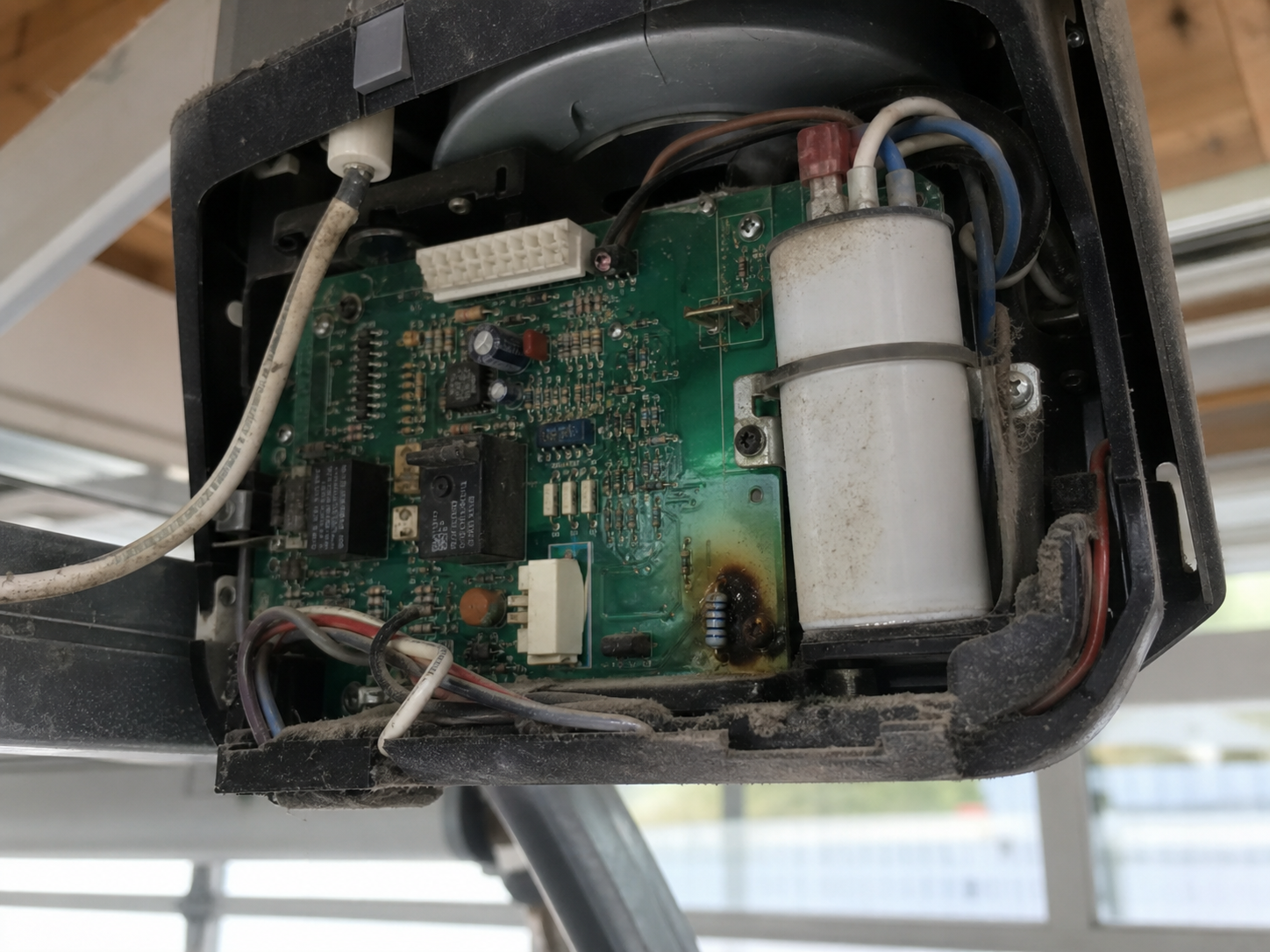
- You smell something burnt near the motor head, or see a scorched spot on the board.
That last one, the burnt smell, tells you almost everything. If you catch even a faint electrical odor near the motor head, stop poking at it and get an emergency garage door repair tech out. A cooked board can leave live traces, and it is not worth the risk.
The three parts that actually take the hit
When a voltage spike reaches the motor head, it looks for the most sensitive thing to destroy. On a garage door opener, that order is pretty predictable.
1. The logic board
This is the brain. It reads your remote, runs the safety sensor circuit, and tells the motor when to start and stop. A surge burns transistors and fuses microchips, and once the board is gone it usually will not come back. A dead board is why the wall button feels lifeless and the remotes get ignored. It does not take a direct lightning hit either. A strike a block away in Northbrook can push enough voltage down the line to kill a board.
2. The starter capacitor
The capacitor is the part that gives the motor its kick to start turning. When it fails, you get the classic hum with no movement, the motor straining against a door that will not lift. This is the good news scenario. A capacitor is a cheap part and a fast swap for a tech, and it is the reason I always test before recommending a whole new opener.
3. The sensors and consoles
A hard surge can also corrupt the photo eye safety sensors or the wall console. If your board survived but the door reverses halfway or refuses to close, check the little photo eye lenses at the bottom of the tracks first. A knocked or fried sensor is a common storm casualty, and it mimics a bigger problem. Our full garage door opener repair page walks through the sensor tests in more detail.
Try this before you call anyone
Work through these in order. Most storm calls I get are solved somewhere in the first three steps, and none of them need a tool more complicated than a phone flashlight.
Check the outlet the opener is plugged into
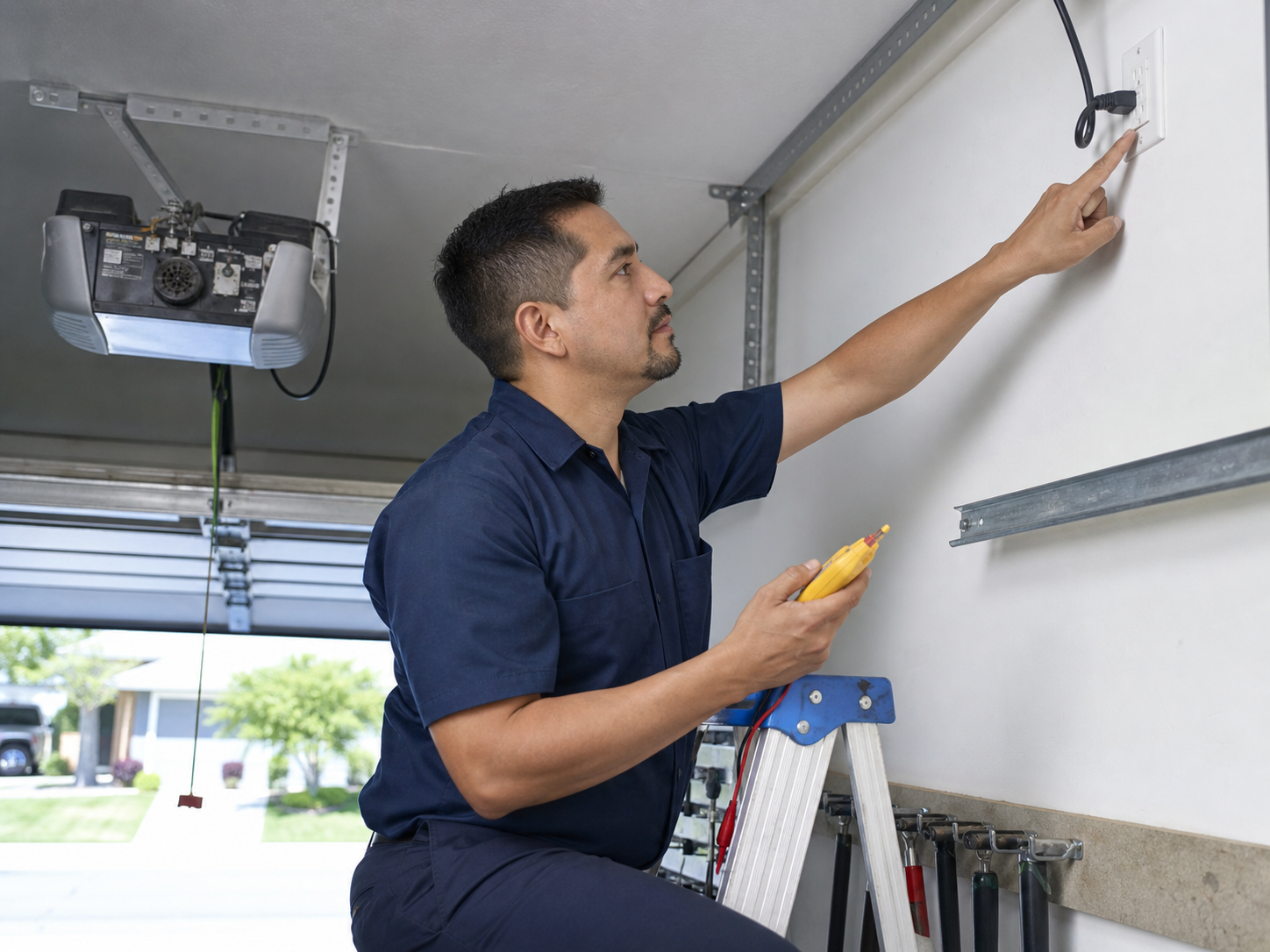
Many openers sit on a GFCI outlet in the ceiling. A surge trips it constantly. Find the outlet, press the reset button, and listen for the opener to power back up. This alone fixes a huge share of storm calls.
Reset the breaker
Go to the panel and flip the garage circuit fully off, wait ten seconds, then back on. A surge can leave a breaker in a half-tripped state that looks on but is not passing power.
Plug something else into that outlet
A lamp or a phone charger tells you in five seconds whether the outlet is live. If the lamp is dark, your problem is electrical, not the opener, and an electrician is your next call.
Pull the manual release and test the door by hand
With the opener powered off, pull the red manual release cord and lift the door. If it glides and holds, your springs are fine and the fault is purely electronic. If it feels heavy or slams, you have a separate balance problem on top of the surge.
Look and smell before you reprogram
Open the light cover on the motor head. A brown scorch mark or a burnt smell means the board is done and no amount of reprogramming the travel limit or force setting will save it.
Repair or replace, and what it should cost
This is where a lot of homeowners get talked into a new opener they did not need. My rule is simple. If the door hardware is sound and the opener is under roughly ten years old, you fix the part that failed. Here are the ranges you should expect in the Chicagoland market, parts and labor together.
| What failed | What it involves | Typical range |
|---|---|---|
| Starter capacitor | Test and swap a single part | $80 to $150 |
| Logic board | Replace the control board on a repairable unit | $150 to $350 |
| Photo eye sensors | Replace and realign the safety sensor pair | $90 to $180 |
| Full opener replacement | New motor unit installed and programmed | $400 to $800 |
A capacitor swap versus a new opener is the difference between a hundred bucks and eight hundred. That gap is exactly why I always diagnose the specific failure first. LiftMaster and Chamberlain share a lot of internal parts, so boards and capacitors for those are usually quick to source and easier on the bill. You can see how we handle these on our garage door repair pricing page, and if the door itself came off balance in the storm, that is covered under garage door spring repair.
A quick story from a Buffalo Grove driveway
Last week a homeowner off Dundee Road was ready to buy a new opener. Storm the night before, opener totally dead, no lights, nothing. He had already priced replacements online. I asked him to check the ceiling outlet before I drove out. Thirty seconds later he called back a little embarrassed. Tripped GFCI. Reset it and the opener came right back. Cost him nothing but the phone call. That is the whole point of checking first.
How to stop the next storm from doing this again
Illinois summers bring the surges and the winters bring the freeze-thaw swings, so your opener takes a beating year round. Two cheap moves make a real difference. Plug the opener into a quality surge protector rated for the motor, and if you own the home, ask an electrician about a whole-house surge protector at the panel. It guards the opener, the furnace, and every board in the house at once.
While you are at it, run a quick balance test each season. Pull the manual release, lift the door halfway, and let go. A healthy door on a good torsion spring holds its position. If it drifts, the springs are tiring, and that strain shortens the life of whatever opener you just fixed. When in doubt, we are happy to request an inspection and give you a straight answer, or you can browse all garage door services to see what we cover.
Opener still dead after the checks?
Skip the guesswork. We diagnose the exact failed part, quote it straight, and most storm repairs are done same day across Wheeling and the north suburbs.
☎ Call 847-789-1175Frequently asked questions
Can a power surge really kill a garage door opener that was working fine?
Yes. A surge does not need a direct lightning hit. A strike down the block can push enough voltage down the line to burn the logic board or the capacitor. That is why an opener can work perfectly one evening and be completely dead the morning after a storm, with no visible damage on the outside.
My opener hums but the door will not move. Is that the board or the capacitor?
A hum with no movement points to the starter capacitor far more often than the board. When the capacitor fails, the motor loses the kick it needs to start turning, so it strains and hums. A capacitor is a cheap, fast fix, which is good news compared to a fried logic board that leaves the unit fully unresponsive.
What should I check first before calling for repair?
Start with the outlet. Most openers run off a GFCI receptacle in the ceiling that trips during a surge. Press its reset button, then flip the garage breaker off and back on. Plug a lamp into the same outlet to confirm it is live. Those three checks solve a large share of dead-opener calls without a service visit at all.
Is it worth repairing the opener or should I just replace it?
If the opener is under roughly ten years old and the door hardware is sound, repairing the failed part is almost always the smarter money. A capacitor runs about $80 to $150 and a logic board $150 to $350, versus $400 to $800 for a new installed unit. We diagnose the specific failure first so you are not paying for a replacement you do not need.
Written by the field team at Garage Doors Illinois. We service Wheeling, Buffalo Grove, Arlington Heights, Northbrook, and the surrounding Chicagoland suburbs, drawing on more than a decade of hands-on garage door repair work.